
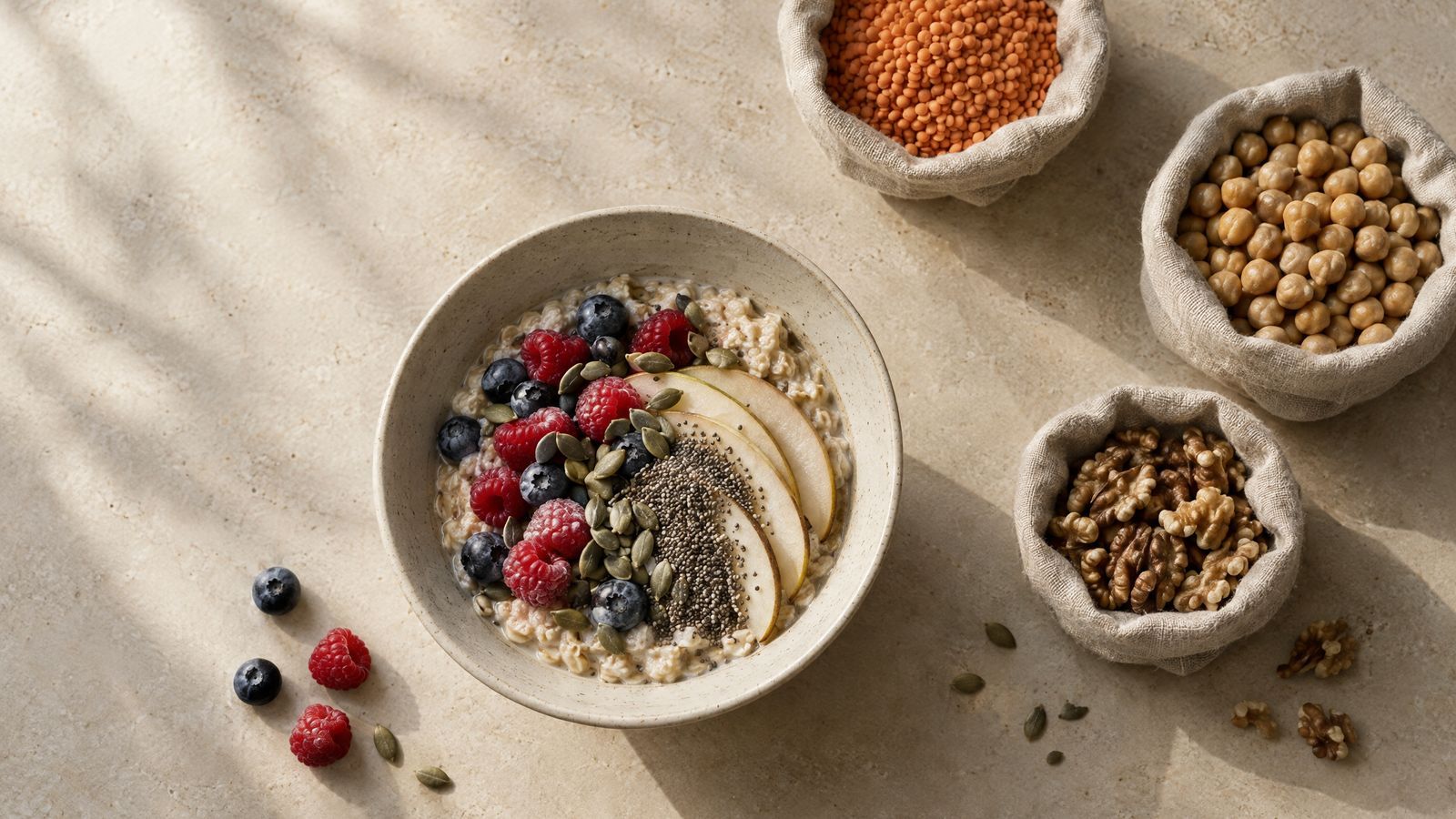
Social media is currently awash with the term ‘fibre-maxxing’ which, like similar trends such as sleep-maxxing, protein-maxxing, refers to the deliberate maximising of a particular thing. But does consuming large amounts of fibre really deliver additional health benefits, or has the internet exaggerated the claims?
Low fibre intake has been at the forefront of concern for leading British health organisations. The UK Scientific Advisory Committee on Nutrition (SACN) recommends that adults should aim to consume 30g a day of dietary fibre. Before 2015 the recommendation was equivalent to around 24g per day, but following growing evidence of its critical role in health it was increased.
Much of the evidence comes from large-scale research such as a 2019 systematic review and meta-analysis published in The Lancet. It found higher dietary fibre was consistently associated with lower risk of several non-communicable diseases - conditions that are not caused by infection such as heart disease, type 2 diabetes and colorectal cancer. The study claims that the association could be causal which means it is the fibre directly contributing to the lower disease risk.
A 2023 meta-analysis, combining results of multiple studies, similarly found that higher fibre foods from a variety of sources lowered mortality. In a separate 2023 randomised trial involving 17 participants, researchers compared a standard western diet and a microbiome enhancer diet (MBD). The MBD consisted of minimally processed foods and resistant starch, which are types of carbohydrates that ‘resist’ digestion in the small intestine allowing gut bacteria to ferment it or what we commonly refer to as ‘feeding your good bacteria’. It is during this fermentation process that the gut bacteria produce short-chain fatty acids providing energy to the cells lining the colon and regulating inflammatory and metabolic processes.
The study found that the MBD generated significant changes in the gut microbiome and increased microbial fermentation which may lend some support to the fibre-maxxing trend.
As with most aspects of nutrition, individual variation matters and personal response to fibre levels will determine how much you should be consuming. The evidence strongly supports the UK recommendation of roughly 30g per day being beneficial. Although gradually increasing this to between 40-60g per day for those who can tolerate it may be safe and effective, there isn’t sufficient evidence that the benefits continue to increase.
The important take-away from fibre-maxxing then is not to ingest large amounts of fibre simply because more is better but to ensure they are from whole food sources and consist of a variety. These sources can come from foods such as oats, lentils, beans, berries, vegetables, nuts and seeds.
Sources and further reading
- Scientific Advisory Committee on Nutrition (SACN). Carbohydrates and Health. London: The Stationery Office; 2015.
- Reynolds A, Mann J, Cummings J, Winter N, Mete E, Te Morenga L. Carbohydrate quality and human health: a series of systematic reviews and meta-analyses. The Lancet. 2019;393(10170):434–445. doi:10.1016/S0140-6736(18)31809-9. View source
- Hajishafiee M, et al. Dietary fiber intake and all-cause and cause-specific mortality: an updated systematic review and meta-analysis of prospective cohort studies. Clinical Nutrition. 2023.
- Corbin KD, Carnero EA, Dirks B, et al. Host-diet-gut microbiome interactions influence human energy balance: a randomized clinical trial. Nature Communications. 2023;14:3161. doi:10.1038/s41467-023-38778-x. View source
This article is general information, not medical advice, and doesn’t replace a consultation. Whether a treatment is right for you — and at what dose — is a decision made with a PPRX clinician who reviews your history.
Explore vitamins & wellness
Zooki supplements and five PPRX bundles, chosen for the things people ask us about most: nutrients, hydration, muscle, sleep, hair and skin.
Explore vitamins & wellness